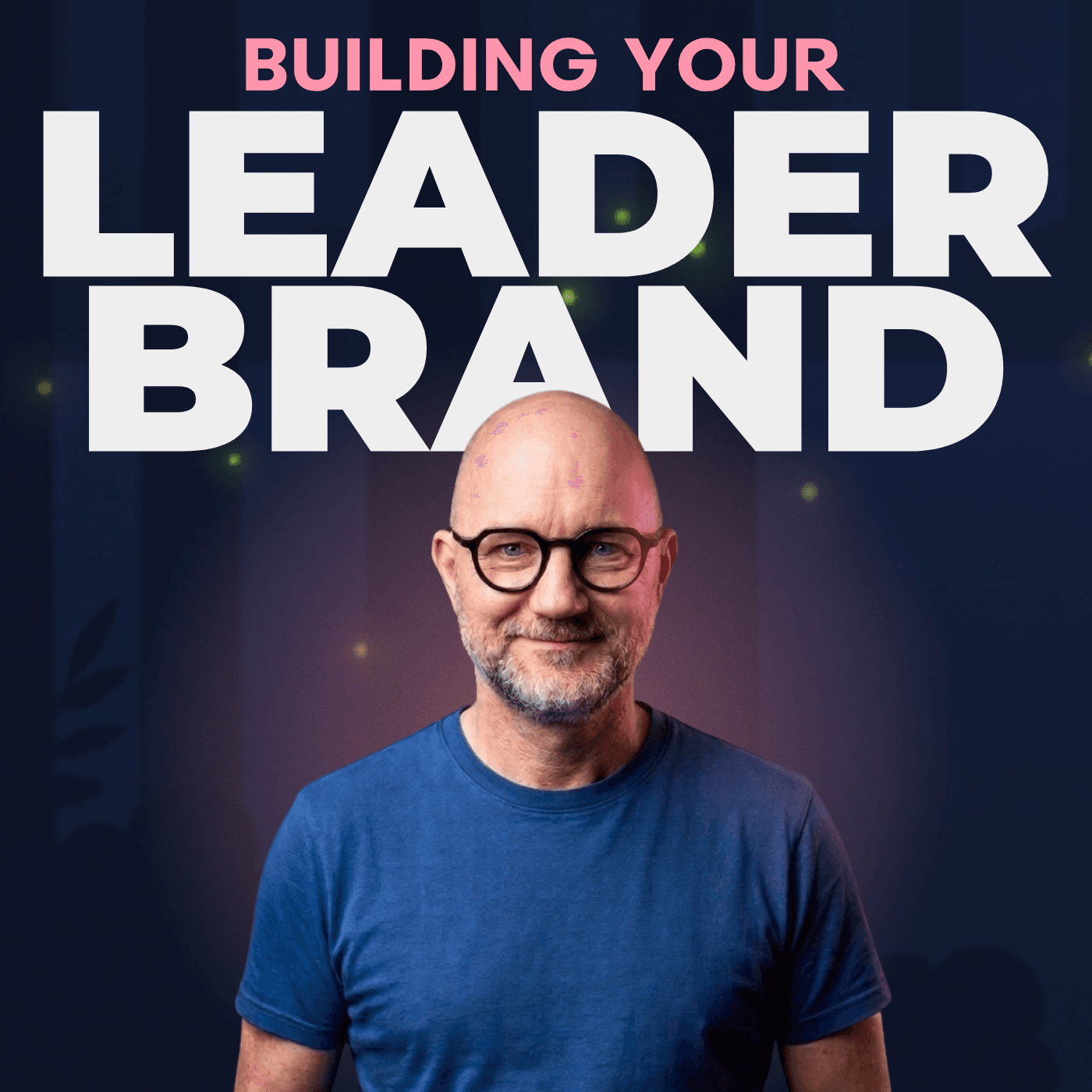
How to Lead as an Introvert Without Pretending to Be an Extrovert, with Greg Weinger
38:02 · Episode 363
Episode 363 · 2026-11-23
How to Lead as an Introvert Without Pretending to Be an Extrovert, with Greg WeingerHow to Lead as an Introvert Without Pretending to Be an Extrovert, with Greg Weinger
0:00 / 0:00
Most of the senior people I work with have heard the same advice at some point. Speak up more. Show more presence. Be more visible in the room.
A lot of thoughtful leaders find that advice never quite fits. They get results and people trust them, and yet they’re told the way they show up is the problem.
This week I’m joined by Greg Weinger, a tech executive with 25 years in growth-stage companies and host of The Introverted Leader podcast. When Greg first said he wanted to be a manager, people were surprised. He didn’t look the part. He went on to sit on executive teams anyway, and now helps quiet professionals lead in a way that’s true to who they are.
If you’ve ever felt that being known for your work means becoming someone you’re not, this one’s for you.
In this episode we explore:
✳️ Why quiet leaders often carry the most weight in the room - and the two executives who showed Greg what that looks like, including a CFO who steered a company through crisis by being honest about what he didn’t know.
✳️ “Greg Plus” - how to show the excitement you really feel without it feeling fake, and why every part of your personality is still the authentic you.
✳️ How to make visibility feel like service rather than self-promotion, and how to move from deep analysis to a clear decision when the moment needs one.
Greg’s Amplifiers:
✳️ Walk in nature every day - Greg’s daily walk with his dog in the local park is one of his anchors.
✳️ Try breathwork - start with box breathing to steady your nerves before big moments, then look into deeper, practitioner-led work such as holotropic breathwork.
✳️ Explore Sam Harris - his Making Sense podcast and the Waking Up app, which includes the full Alan Watts lecture library.
Greg’s free 30-minute masterclass, Why Everything You’ve Heard About Getting Ahead as an Introvert Is Wrong, is at gweinger.com/masterclass.
If this episode was useful, follow or subscribe so you don’t miss the next one. And if you know someone who’s been told to “speak up more”, send it their way.
Please take a second to rate this show in Apple Podcasts. ❤ It will mean a lot to me.
Read transcript
Speaker 1 (00:01) This week's show is supported by Granola, the AI note-taker, and this is a tool I use myself every single day. As a culture advisor, Granola gives you complete flexibility in how you stay compliant, inform your clients, and handle consent. There's no bot joining the call, just a quiet, unobtrusive capture running on your device in the background. It works across everything: Zoom, Riverside, Google Meets, SquadCast, and on your own phone for in-person sessions too. The real superpower is querying everything across all the calls you've ever recorded, drilling down into a single client's entire history in seconds, or just asking a question about the call you had yesterday. You can set up your own custom reports, spot patterns across your practice, and connect it to all your favourite tools— Notion, HubSpot, Zapier, and much, much more. And this is not just a note-taker, it's a second brain for your practice. And thanks to the nice people at Granola, if you use the link go.granola.ai, forward slash Bob, they'll extend your 1-week trial to a full month. That's go.granola.ai/bob. Speaker 2 (01:15) Welcome to Building Your Leader Brand. Today on the show, Bob is speaking with Greg Weinger. Speaker 3 (01:23) The number one thing I would tell myself is don't be afraid to fail. Don't be afraid to make mistakes in a public way. Don't be afraid to try things for fear that it's not going to work out, because that's how you learn. And that's the fastest path to getting where you need to go. Speaker 1 (01:46) Hi there, and welcome back to Building Your Leader Brand. My name is Bob Gentle, and every week I speak with incredible people who share their secrets to building, marketing and monetising their expertise and the mindset you need for your business to grow and thrive. If you're new, before you get too carried away with whatever it is you were planning to do while you listened, stop, pick your phone up again and unlock it with that gorgeous face of yours and hit the follow and the subscribe buttons. That way you won't miss a single thing. My numbers go up because numbers going up is my literal favourite thing in the world. after Neapolitan ice cream, which is quite childish. If you enjoy shows like this, you'll love the Personal Brand Business Roadmap. It's one— why am I doing this? Every week I say it's one, and I say it's not 100, it's 50 pages of everything you need to start, scale, or fix your expert business. Just visit amplifyme.agency/roadmap. My guest today has spent over 20 years proving that you don't need to be the loudest voice in the room to lead effectively. Greg Weingart is a tech executive, a Stanford graduate, and the host of The Powerful Introvert podcast, where he helps quiet professionals turn their natural calm thoughtfulness and empathy into genuine leadership assets. Speaker 1 (03:09) His work challenges one of the biggest myths in business, that great leaders are born extroverts. Greg, I'm so glad I got through that. Welcome to the show. Speaker 3 (03:20) Thanks so much, Bob. It's a real pleasure to be here. with you here on the show and really to spend more time with you. Speaker 1 (03:27) So I'm really looking forward to this. And thank you for bearing with me. If you're the listener, I probably tried that intro 3 times. I'm usually better than this. So Stanford graduate, you work in tech, you have the awesomely named The Powerful Introvert podcast. Speaker 3 (03:46) Well, let me just correct that or just amend that. I rebranded The Powerful Introvert podcast to The Introverted Leader. to reflect my focus on leadership. Powerful Introvert was a kind of a nickname that I got from a colleague, which I just adored. That got me launched with the whole enterprise. But I really wanted to make sure that people understood who the audience is for that. And it's, you know, that was my experience is how do you make your way as an introverted leader? So that's, Tried to make it a little bit more on the nose. Speaker 1 (04:22) When did you do that? Speaker 3 (04:24) I did the rebrand at the beginning of this year. So I had— this has been my second full year of doing the podcast. And after the first year, you know, I wanted to see how I could reach more people. And so with the rebrand and the types of things that I was doing with the podcast, I've expanded the audience quite a bit. Speaker 1 (04:43) So for the listener who's meeting you for the first time, Could you maybe just give us a potted summary of what it is that you spend your days doing, who the listener for the podcast is, and why you did it? What motivated you to do it? Speaker 3 (05:01) Yeah, absolutely. I spend my days working in a tech company, as I've done for the past 25-plus years. I was in California for a while in San Francisco, Los Angeles. I moved up to Portland about 20 years ago and have been in growth-stage startup companies, which is— there's a lot of growth, a lot of uncertainty, chaos. It's where I personally thrive as an individual because it just offers a lot of interest. I've never been bored probably in 25 years on the job. Lots of opportunities for growth, filling in spaces, and it's a really dynamic kind of environment. And over the course of that time, I really was working on my leadership. I wanted to rise in leadership, and I did, but I found it challenging, more challenging than I expected. I came from a very achievement-oriented background, and you study hard, you do the work, you get the result. That's the academic experience that I had. And, you know, You know, in the world, it's dynamic, and then you're dealing with things like people and leadership and different personality types. So that was a surprise for me. And, you know, it took me longer to find my way to lead, and— but I did. Speaker 3 (06:25) And what I found was that initially I was not encouraged. I was discouraged on my path. And it was really only after being on executive teams and needing to do some personal transformational work to really have the resources to perform at that level, that I came across research and information that really went into personality types. And, you know, I think there was sort of a watershed moment for many people I've spoken to on my podcast, starting with Susan Cain's work, her book Quiet. So early teens, some people came across this sooner than I did, but it gave a language, deep research, and in many ways a permission structure to be how you are, to be your authentic self and not to have to buy into this dominant model of an extroverted leadership. And coming out of that, I just wanted to share this information. I felt like it hadn't reached me and it needed to be Spread more widely. And I really have this other aim, the side aim. So I still work at my job, my day job, but whatever I could do to help influence the culture and create a ripple effect to change it, you know, one person at a time. Speaker 3 (07:44) That's why I started the podcast. And it was really directed at my 30-year-old self. Anyone who's embarking on a leadership journey should know these things. Speaker 1 (07:55) I think one of the challenges that young people have, and honestly, it doesn't matter what age, but when you come into a dynamic organisation, which I have really avoided doing, I've only worked in other businesses for about 2 years of my whole life. But something you absolutely notice is there are certain people stand out and they stand out because they're very visible. There's a lot of razzmatazz. And often those people who are super visible, they get noticed and progression happens. And so we fall into the assumption of thinking, well, that's what leadership looks like because that's what appears to get results. Was that something that influenced your early career? And was there a moment— I mean, you kind of hinted at this, but— What was the moment where you saw somebody else doing things differently? Did you have any introvert role models in leadership? Speaker 3 (08:55) As it turns out, I have. Sure. No, that's great because there's always role models. And my early experience was expressing interest in, oh, I want to be a manager. And then people are like, you really? I wasn't presenting that way. And then As I made my case and then was given opportunities and learned and progressed, it was probably helpful for me that I was working on engineering sides of the organisations first. So I am on the more extroverted side in those rooms. It became a training ground where I am more vocal than most of my peers on the engineering organisation. There are exceptions, of course, but I would hold my own, and then I'd go work with marketers and people in sales, and then I'm the quiet one. So I had to learn how to become visible in those places. But it was always my managers, my mentors, still for a long time, were just giving me the standard advice. You need to stand out more, speak up louder, and all these kinds of, kind of, sort of the classic advice. Show more confidence, executive presence. None of the advice is helpful for me personally because I just— the advice was you need to develop your own style. Speaker 3 (10:16) You pick your spots, you need to manage your energy, all those kinds of things. But I was fortunate to have a couple of really powerful examples in the executive level as I was coming up. And the first example I like to give, he was the number 2 in a company. And he was the strategist. And he was quiet. He was always very quiet in meetings, but he did not lack confidence at all. What would happen was we'd sit in this meeting and people would debate back and forth. They'd present the case and he'd be kind of sitting there, you know, waiting back. And everyone knew he was cooking up something and his opinion really mattered. And at the end, he would weigh in and he would He would either have this really kind of crushing criticism or he would say, oh yeah, this is great. I can support this. And it was really great when it went your way. But yeah, he would absolutely hold the room until— and he was also really interesting. He was one of the first people who was not afraid of silence at all. Even one-on-one, you would sit with him. Speaker 3 (11:31) And he would just wait and think, and long after it became very uncomfortable for you until he responded. And he felt no pressure in the world to respond, that kind of thing. So that was one example of a powerful leader who was quiet. There was a second example. It was this CFO of a company, and a company— you're talking about turmoil. This company was on an absolute rocket ship trajectory, was headed, probably headed toward IPO. And just right moment, right time. And the executive, the CEO, is very flashy, very prominent member of our community, and encountered this kind of a MeToo scandal some years before that became very prominent. And it was devastating to the company. And people just didn't know, was the company even going to continue? Because he was so integral to the shape of that company. And the person who emerged from this was our CFO, and he was a quiet individual. Again, didn't lack confidence, but was not out in front, loud, flashy, calling attention to himself. Was very dignified and What was amazing was just the way that he showed his vulnerability in the situation, saying, I don't— he was very truthful. Speaker 3 (13:01) This is what I know. This is what I don't know. He'd even share how he felt about it. This is super challenging, but we are going to get through this. He led that company through an incredibly touchy moment because emotions were so high. It wasn't just that there was uncertainty. This was a really potentially polarising thing that could have torn the company apart. And with his gravitas and emotional intelligence, I think he surprised himself, and that's part of his journey through this that he shared. He surprised himself how well he came through that, and it saved the company. Speaker 1 (13:45) So as you've been speaking, the question emerged, as somebody who's occupied with being an introvert, supporting introverts, thinking about introversion, if you could go back, teleport, and you only had 10 minutes with 15-year-old you, Hmm. what advice might you offer? Because I think that this, this for me is, we've got limited time, there's constraints, you need to listen to me. What comes next? Speaker 3 (14:20) I don't know how much this ties into the introversion part of it. I think it does. But the number one thing I would tell myself is don't be afraid to fail. Don't be afraid to make mistakes in a public way. Don't be afraid to try things for fear that it's not going to work out, because that's how you learn. And that's the fastest path to getting where you need to go. Speaker 1 (14:52) I like that. So in terms of leadership and visibility, the extrovert path is kind of obvious. And the introvert path is often overlooked. And I remember, I'll tell you a story. So I worked for 15 years in search and rescue, and it was like a volunteer role, but I was always on call for 15 years. At the drop of a hat, I had to go and do crazy stuff. And I was on probation, and I think I was in my late 20s when this started. And it was the most exciting thing I'd ever done. And 6 months later, my probation ends, and the boss calls me into the office and he says, we're going to extend your probation. And I thought, why? I've never heard of this happening before. And he said, the reason for this is we just don't know if you're into this. We don't really want to— have you along if you're just being a passenger here? I thought, what? And I said, look, this is the most exciting thing I've ever done. And he said to me, well, you better tell your face because nobody really thinks you're into it. I thought, oh my goodness. Speaker 1 (16:11) That was a real watershed moment for me, that what's on the inside needs to find a way out for other people. And I think a lot of people can probably connect with that, that the way that we present to the world compounds. And for outgoing people, this is really obvious. But if you're not somebody who is naturally expressive, it's a real disadvantage. So if you were advising somebody who's— maybe you're not going to say introvert, but somebody who's not naturally very expressive— Speaker 3 (16:44) Mm-hmm. Speaker 1 (16:46) To be a little bit more strategic about this, What might that look like? Is that even a fair question for you? Speaker 3 (16:53) Yeah, I encountered a similar kind of experience. It wasn't expressed to me directly as feedback, but it became obvious at a certain point that when I did feel passionate about it, that, that it wasn't completely clear. And I actually set out on a programme to start to express appreciation for people. And maybe, you know, I had also a little bit of— I came from a high-achieving family and, you know, you get kind of a couple nods for like the very top achievements, but, you know, everything else is just expected, you know? And so I naturally tended to treat people that way and Realised at a certain point, also observing other leaders and observing that I actually did appreciate it when I got more attention or appreciation for the job I'm doing more day to day, or the way I did certain things. I, I was able to incorporate that toolkit into my management toolkit. But leading large projects and motivating teams to build some ambitious piece of software, I realised that I really did have to communicate more excitement. And I ran into some inner resistance on that, and I had to question why. And there's a voice in me that was saying that that's not authentic. Speaker 3 (18:29) You're not— you don't actually feel that way, so that, that's not authentic. But I had to question that because Because I actually was excited about these things. I was just not used to communicating that. And so I called this programme Greg Plus, where it's just to capture for me that this is authentic. It's just dialling up the volume a little bit. Speaker 1 (18:54) I guess, yeah, it's a little bit of acting almost. You develop an alter ego for specific situations. For me, there was a book called The Alter Ego Effect by Todd Herman that was really helpful, and it helped me Understand that I don't need to be on all the time, but I can develop a persona that I can step into. It's very similar to me, but I don't have to permanently occupy it. I can step out again. It's more complicated than that, but for me, that's the useful component. Speaker 3 (19:25) I've definitely heard that with taking on a role, and if that works for you, then that's great. My view is I have this sort of multiplicity view of personalities, probably borrowed from different places. If you imagine you have different personas or different moods or modes of your personality, and imagine we're all sitting at a very large dinner table. Typically during your life, only a few people at this large dinner table are standing up for most of time. They stand up and speak and interact in the world. There's these other parts of your personality which maybe they don't get as much airtime, much limelight, but they are there and they are part of you. That could even fit into this role, actor role part of you. It's not that that's not you. That is still you. And so to me, and I've found this with other introverts, there's a strong attachment to feeling authentic. And that if you can connect with that part of you, that part is true, then it is still authentic. And there's something empowering in that. Speaker 1 (20:40) So this kind of leads me to where I was going, and you, you've segued really elegantly into it. In person, in a leadership role, we've covered very superficially, but quite nicely and elegantly, where a lot of, often the smartest people I meet are the most reticent to shine. And I have one person in mind that I met who was quite obviously a genius, somebody that you would really want to celebrate. And she just saw— Smart. something like LinkedIn or posting on LinkedIn is absolutely gross. She just felt dirty at the very idea of posting any kind of accomplishment on LinkedIn. And I have a perspective on how you can move through this, but it's my perspective, somebody who occupies themselves again with this space. How do you support people Towards a degree of self-advocacy, particularly with things like social media? Speaker 3 (21:56) Yeah, I mean, social media is so charged with that, but I find probably the most powerful way through that is to find a place of service in this. Most of us have some kind of mission that's larger than themselves, or typically if someone is wanting to have more of an influence with their ideas, that's what's driving it, unless it's just pure greed. I don't think most of the people I encounter are like that. And so there's something motivating you to have an influence in the world or reach more people or help more people. And if you can connect with that and find that, then you can logically connect, well, how am I going to do that? People simply have to find out about you And that can be the bridge for a lot of people. Speaker 1 (22:51) I absolutely agree. I think approaching content marketing as an act of service from a place of mission is the most powerful thing. The other side of it is a lot of the time people assume, because that's what they often see, that we need to be presenting as having the answers. And what's fascinated me is the smarter the people I meet, the more they value great questions, not the answers. So leading with the question and letting people come along with you on the exploration, it speaks to that, you going back to speak to 15-year-old self. Don't be afraid to look like the student. That's the most valuable thing. To smart people, appreciate great questions and people who'll have the courage to explore and let people watch. And for me, that's the definition of thought leadership is leading with your thinking, not leading with your answers. But we don't see that often enough. Speaker 3 (23:57) Yeah. And that's, I think, where thoughtful people, introverted leadership, thought leadership can really shine. The one qualifier I had attached to that is, as a leader, as a senior leader, there are situations where that's less appropriate, where what the moment demands is more decisive leadership or driving to a conclusion. And so discursive thinking, going into depth, nuance, that came very naturally to me. But when I got into senior leadership, I had to bring in This other skill of recognising what the moment called for and realising, okay, I've really got to drive to a decision in this moment. Because 95% of the time, there's always more time, and I'm the one advocating to take a step back and do more analysis and think this through. Let's take a strategic approach here because we've made enough mistakes. We don't need to repeat mistakes. But there are absolutely moments, and this is where extroverts naturally shine, is stepping into the breach and stepping in and taking decisive action. And I happen to really like the blend of those 2. That's the only qualifier I'd have for what you had said. Speaker 1 (25:24) Somebody described introversion to me as internally processing opposed to externally processing, which I thought was a really interesting lens to look at it through. One of the things that has caused me issues in the past is I can hold 2 things as equally true, that there is no binary solution to a lot of situations. Well, You are both correct, but from different perspectives. And no, you need to pick a side. Who's right? What's the right strategy? What's the thing we should do? I'm very comfortable now making the decision, but a long time ago, I really struggled with that because if 2 people came to me and they were arguing and wanted me to pick the right decision, it was quite paralysing. If you're in a leadership role, you have to decide. And people have to accept your decision. And I think as a very secure introvert, or yeah, I think introvert's probably the way to put it, with a lot of experience, you can work your way through that. But if you haven't been through the 7 circles of hell yet, Mm-hmm. You're going to find that a lot harder. How do you help people move past this, the paradox of seeing many different routes as equally valid and being in a situation where you're the guy who has to choose, whereas a lot of other people would just see one obvious route? Speaker 1 (27:09) That's the way we have to go. There is only one route. Does that question make sense? Speaker 3 (27:15) Yeah, absolutely. 2 parts to it that I think you need. One is the framework for making those types of decisions, and the second is just gradual experience with achieving it. In terms of the framework, again, going back to thoughtful people often come from an analytical academic background. They're not necessarily training you in that type of decision-making. When you have infinite time in an academic setting, then you can really go all out. You can research things for years. A PhD takes 7 years, and you can do experiments and all these things. In this other setting where you're being called on to make a decision, you're making decisions based on imperfect information. So you're never going to know all that stuff. Ultimately, you're making risk-based decisions, and that's based on what you know. Because at a certain point, the value of a slower decision, you start to lose the opportunity. So what is enough deliberation before you need to make a decision? So it's just a different framework. And I think working with someone, kind of talking them through that is the first part of it. The second is, with any of these types of changes, whether it's public speaking, you know, being assertive in meetings, speaking up, you start in the smallest comfortable, or, you know, slightly, you go up to your edge where you first have your first bit of discomfort with it. Speaker 3 (29:02) And then you try that, and then you get feedback or you get used to that, and then you start, over time, just adding and pushing out your edge until next thing you know, you're standing in front of 1,000 people speaking. And that's literally the path. And there are some very lucky introverts who have no shyness. I mean, that's one thing that we always talk about is shyness is not the same thing as introversion. You can have shy extroverts. Shyness is just fear, either social anxiety, some kind of a fear. And introversion is really, like you said, it's internally processing, which leads you to having different energy needs in different situations. And that leads to a whole lot of other differences. So once you learn to manage those things with anything that's connected with fears, it's super amenable to gradual transformation, but just by slowly expanding your zone of comfort. And if I could shrink my entire leadership experience, my 20-year career, it's just almost daily, day by day, expanding my zone of comfort. Speaker 1 (30:22) I think people, until you have tested the boundary of your comfort zone, you don't realise how elastic it actually is. I was cripplingly self-conscious and shy as a child. My family are now mortified by the level of confidence that I have in social situations in public. But I don't really get embarrassed anymore. It's almost gone. But the introversion remains. I've really enjoyed this conversation. There are lots of things that would've been very obvious for us to talk about, things like energy management or personality types. But when I've got somebody as smart as you, I would almost be wasting your time with that stuff. One of the things that you mentioned was you had a masterclass that people can take. Can you tell us a little bit about that? Because I imagine it covers an awful lot of the more obvious things. Speaker 3 (31:19) It does. Well, it's less about primer on introversion. The masterclass is called Why Everything You've Heard About Getting Ahead as an Introvert Is Wrong. It's really about 3 central myths of getting ahead. It's obvious things like trying to be louder. You don't have to be louder to get ahead, that sort of thing. There's practical advice in it as well. It's 30 minutes. It's on my website. I am at gweinger.com/masterclass. That's G-W-E-I-N-G-E-R.com and masterclass is one word. Yeah, it's a great compact set of advice that would, as you said, I would've loved to have gotten that bit of the knowledge that's packed into that as when my— 25-year-old self. Speaker 1 (32:20) There will be a link to that wherever you're listening to this. Just go looking for it. And you have a podcast. I am really interested because I know the impact my podcast had on me. It's profound. How has your podcast shifted your perspective, and what impact has it had sort of professionally, emotionally, personally? Speaker 3 (32:45) First of all, the types of conversations that I have with my podcast guests, and I've interviewed close to 90 at this point, is one of the joys in my life. Just spending time with really incredible individuals who are— we go back to that point of service— that are doing mission-driven things. They're doing things because they passionately believe in the impact that they have. They've seen it in their own lives and/or the lives of their clients. And they're trying to communicate that. Prior to the podcast, I didn't have anything in my life that was like that. And it's been— it in itself has been a transformational experience in giving me a sense of meaning and purpose. And I've become— I've learned a ton about podcasting and production, that whole aspect of it. I've automated all of this stuff. The use of AI has been really fun in the last year. To learn how to just take out really the drudgery of production out of the mix has been sort of the number one thing. So it's been impactful on many different levels. Speaker 1 (33:56) I think a lot of people listen to podcasts and they get a lot out of it, but what they don't realise is the value to the host of the compound effect of spending time with amazing people. It's quite profound. So we need to get into your amplifiers. So these are things that people can go and do, they can listen to, they can eat. And honestly, there are no limits here. These are 3 things that you find valuable that you want to share. So Greg Vinger, amplifier number 1. Speaker 3 (34:33) Number one is to walk in nature, whatever access you have to it, every day. So I have a daily walk with my dog at our local park, and that in itself has been, again, one of my joys in life and has been transformational to me. Speaker 1 (34:56) I am puppy sitting at the moment. That's my job after dinner. Amplifier number 2. Speaker 3 (35:01) Number 2 is breathwork. And there's 2 flavours. There's sort of measured counting breathwork that you can do and incorporate in a meditation session or during your day. You can do box breathing to regulate yourself. And as someone who would get nervous in different situations, confrontations or public speaking, that kind of thing, That's been huge. But that's almost like a tiny appetiser, amuse-bouche, compared to the type of breathwork you can do to support personal change. And so there's a whole other thing. Look into either holotropic breathing or I think, I'm not sure Wim Hof goes quite in this direction, but there is the kind of breathwork that you probably don't get from an app that you probably need to go to a class or a practitioner or a session. That is what has allowed me to make some of the, the deeper changes in my things that you talk about, like your edge, things that you just can't get over the hump in another way. That's something I would recommend people look into. Speaker 1 (36:17) I heard a fascinating, spectacular breathwork story the other day, but it's not for this podcast. I am intrigued. We'll leave it there. Amplifier number 3. Speaker 3 (36:34) So I'll, I'll throw the name of Sam Harris in there just because he has meant a lot to me, you know, over the past probably 10, 12 years. One, his podcast Waking Up— there's a Waking Up podcast, but, uh, or Making Sense is his podcast, and And his app is Waking Up, and that is a meditation app. But what makes it truly unique is the vast library of lectures and speakers. Like the entire Alan Watts library is there available for download. If you've never listened to any of those, it's just fascinating. But in terms of a— he brings a little bit of a more secular approach to meditation, mindfulness, all that stuff, which I think can reach some people who might be put off by anything that has the faintest whiff of religiosity in it. And so definitely love his mind, love his sense of humour, and would recommend that to anyone who hasn't experienced him. Speaker 1 (37:45) I'm going to have a look at that. I think it's Very serendipitous timing for me. We are going to have to bring things to a close because the listener doesn't know, but Greg does. I have to have dinner in under 60 seconds. I have had so much fun. Again, if people want to get closer to you, if they want to find out more about you, one more time. Speaker 3 (38:08) One more time. Just search for The Introverted Leader on anywhere that you listen to podcasts, Apple, Spotify, YouTube, or go to my website at gwenger.com, G-W-E-I-N-G-E-R.com. I'd love to hear from you. Speaker 1 (38:25) That does bring us to the end of another episode. Thank you so much for spending some of your time with us today. I really do appreciate it. If you enjoyed this show, you will love the Personal Brand Business Roadmap. 50 pages, not 100. I don't know where that keeps coming from, of everything you need to start, scale, or fix your expert business 100% free as a gift from me. Just visit amplifyme.agency/roadmap. If you have enjoyed this show, then I would invite you to leave a 5-star review. That's 5, like the fingers on your hand. Count them if you're unsure. Wherever you listen to podcasts, it means an awful lot to me. Again, thanks at home for listening. And Greg, you have been awesome. Thank you so much for your time. Speaker 3 (39:05) Thanks so much for having me on your show, Bob. Speaker 1 (39:07) It's my pleasure.